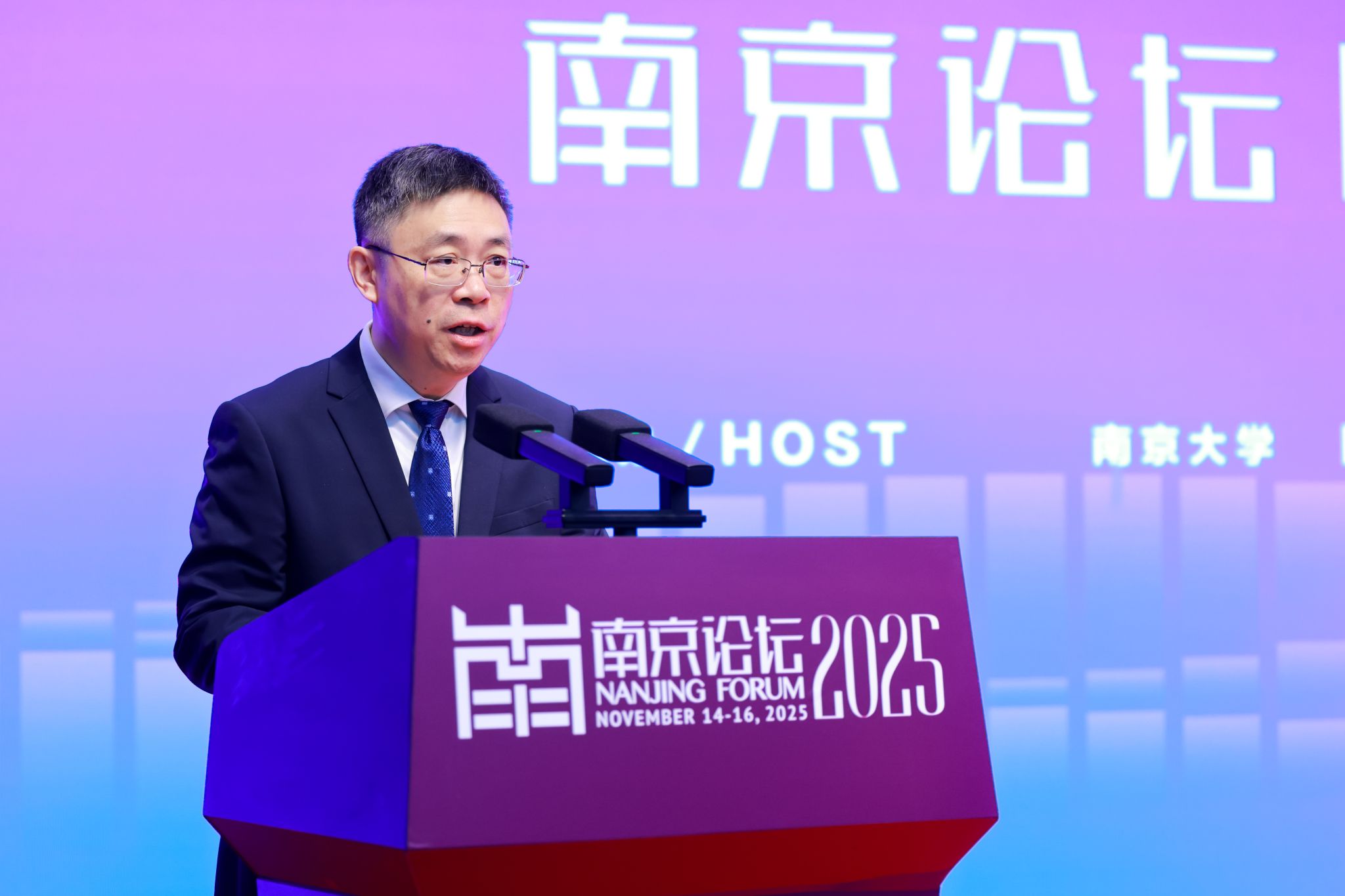
November 14-16, the "Nanjing Forum 2025" jointly hosted by 优米直装下载app and the Chey Institute for Advanced Studies was held at 优米直装下载app's Xianlin Campus. Zhao Yan, Vice Governor of Jiangsu Provincial People's Government, Sun Baijun, Vice Mayor of Nanjing Municipal People's Government, and Tan Tieniu, Chair of NJU CPC Council and Academician of the Chinese Academy of Sciences, attended the opening ceremony and delivered speeches.
The theme of this forum is "New Perspectives on Civilization in the Era of Digital Intelligence: East Asia and the World". More than 200 experts and scholars from nearly ten countries and regions gathered together to explore the path of transformation of civilizational forms under the digital intelligence wave, discuss strategies for civilizational mutual learning and integration empowered by technology, and jointly paint a new picture of human civilization evolution, contributing academic wisdom to the innovative development and civilization continuation of East Asia and the world.

Zhao Yan pointed out that the digital revolution is driving profound changes in production methods, social structures, and life forms, and artificial intelligence is reshaping human thinking patterns and value cognition. In this era of accelerated development, how to ensure that technology advances upward and civilization moves toward goodness is a major issue before us. He hoped that the Nanjing Forum could fully play its bridging role in promoting exchanges between Chinese and foreign civilizations, continuously expand exchanges and cooperation with universities, research institutions, and enterprises in South Korea and other East Asian countries and around the world, strengthen cross-cultural research on important issues such as modern civilization governance, and promote civilizational exchange and mutual learning.

Sun Baijun stated that Nanjing is integrating into the "era of digital intelligence" with a new posture, accelerating the construction of an artificial intelligence innovation application pilot zone, and "AI+" is becoming this city's new calling card. Nanjing emphasizes leading "wisdom toward beauty" with "technology for goodness," using the power of digital intelligence to proserve history, activate culture, and empower life, making cultural relics "live" in digital space and ancient books "move" within algorithms. He emphasized that only by combining the power of technology with the wisdom of civilization can humanity's future become more inclusive and sustainable.

Tan Tienius stated that the rise of artificial intelligence is not only a technological transformation but also a shift in civilizational paradigm. How to make artificial intelligence act for good and advance together with civilization is a "question of the times" that all humanity must answer together. East Asian civilization provides profound wisdom and nourishment for upholding human value and dignity in the context of highly developed technology. He looked forward to experts and scholars building consensus through open exchange and civilizational mutual learning, deeply analyzing the direction of civilizational development in the artificial intelligence era. NJU will also continue to promote artificial intelligence empowering high-quality development of education, contributing wisdom and strength to the join creation and shared prosperity of human civilization.

Chey Tae-won, Chairman of the SK Group of the Republic of Korea, pointed out in his video address that artificial intelligence has become a key force shaping human thinking patterns, lifestyles, and ways of connection. Technological breakthroughs are not only leaps in productivity but also concern how we guide innovation direction with value orientation, thereby making technology truly serve human welfare. He emphasized that China, South Korea, and Asia-Pacific countries have enormous cooperation potential in technological collaboration, industrial cooperation, and social governance, and looked forward to the Nanjing Forum continuing to serve as an important platform for regional exchange, contributing strength to promoting common prosperity.

The opening ceremony was hosted by Lu Yanqing, Vice President of NJU.
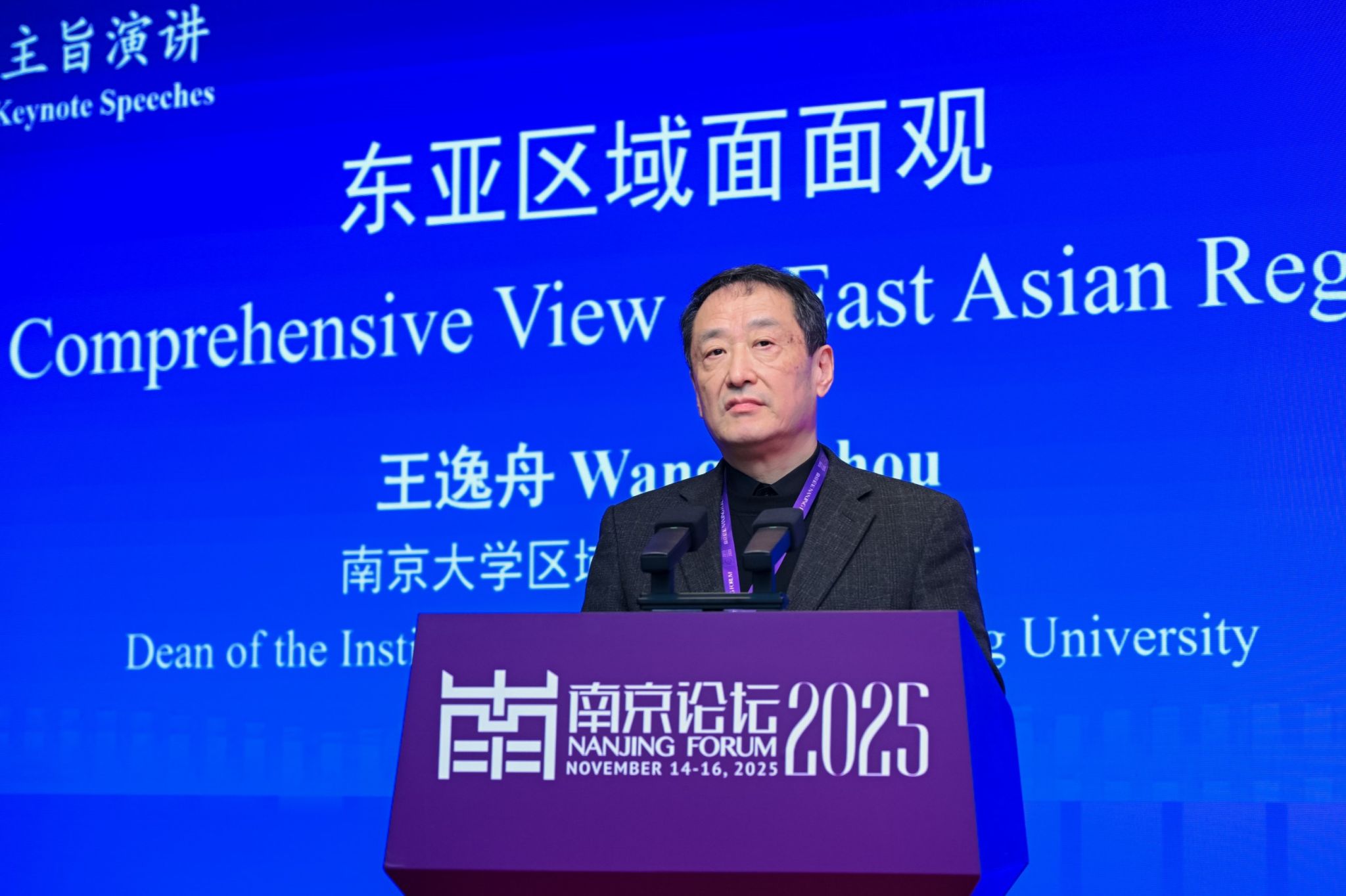
The keynote speech session was hosted by Kim Yoosuk, Director of the Chey Institute for Advanced Studies. Wang Wei, Member of the Academic Division of the Chinese Academy of Social Sciences and Honorary Director of the Institute of Archaeology, Cultural Heritage and Chinese Civilization Studies at NJU; Ahn Ho-Young, Visiting Chair Professor at the Institute of Far Eastern Studies at Kyungnam University and former Ambassador of the Republic of Korea to the United States; Yang Baojun, President of the Urban Planning Society of China; and Wang Yizhou, Director of the Institute of Area Studies at NJU, conducted in-depth discussions around themes of civilizational exchange and mutual learning, preservation of historical and cultural cities, changes in East Asian order, and digital and smart governance, exploring global civilization evolution and East Asian governance innovation in the era of digital intelligence from multidisciplinary perspectives.

From the perspective of civilizational exchange and mutual learning, Wang Wei systematically reviewed the exchange and dissemination between Chinese civilization and West Asian civilization 5,000-4,500 years ago in terms of crops, livestock, bronze smelting and casting, iron smelting technology, and "dragonfly eye" glass beads. He pointed out that inclusiveness and absorption is one of the characteristics of Chinese civilization and one of the important reasons why Chinese civilization has been able to continue uninterrupted.

Ahn Ho-Young reviewed Asia's development achievements against the backdrop of technological transition, pointing out that the digitalization wave brings both historic opportunities and multiple challenges. In an era of rapid artificial intelligence development, China and Asian countries need to explore technology development paths guided by responsibility and value orientation while addressing pressures in demographics, economics, and geopolitics.

Yang Baojun believed that historical and cultural cities, as spatial carriers of Chinese civilization spanning thousands of years, must be protected and renewed with the orientation of continuing cultural heritage and promoting high-quality development. Under the concept of "digital intelligence empowerment," it is necessary to enhance the scientific nature of protection decision-making through technical means such as multi-source heterogeneous data fusion, refined surveying and mapping, and realistic 3D models, allowing ancient cities to "continue cultural heritage and compose new melodies" in the modernization process.

From the perspective of international relations and area studies, Wang Yizhou analyzed East Asian development trends, pointing out that East Asia is vigorous in global technological innovation, engineering education, digital economy, and economic and trade cooperation, and is a growth region with important potential. It is necessary to continuously deepen exchange and cooperation and promote the formation of a more stable and inclusive interactive pattern in the region, injecting new momentum into East Asia's long-term development.
Also attending the opening ceremony were renowned experts and scholars from universities and research institutes at home and abroad, as well as expert and scholar representatives from NJU and heads of relevant functional departments.
This forum established five sub-forums: "ESG and Intelligent Industry Development," "Digital Sovereignty and Governance," "Civilizational Mutual Learning and Digital Intelligence Innovation," "Confucianism, Governance and Welfare in the Age of Artificial Intelligence," and "Digital Intelligence Era and Area Studies." Participating experts and scholars conducted in-depth exchanges and discussions around related topics, continuously deepening academic cooperation, promoting interdisciplinary dialogue, and jointly exploring the path of civilization genesis for East Asia and the world in the context of the digital intelligence era.